
The Major Arcana as a Map of Spiritual Awakening
Explore the Major Arcana as a symbolic map of spiritual awakening, inner growth, shadow, surrender, and wholeness — beyond fortune-telling or fixed prediction.

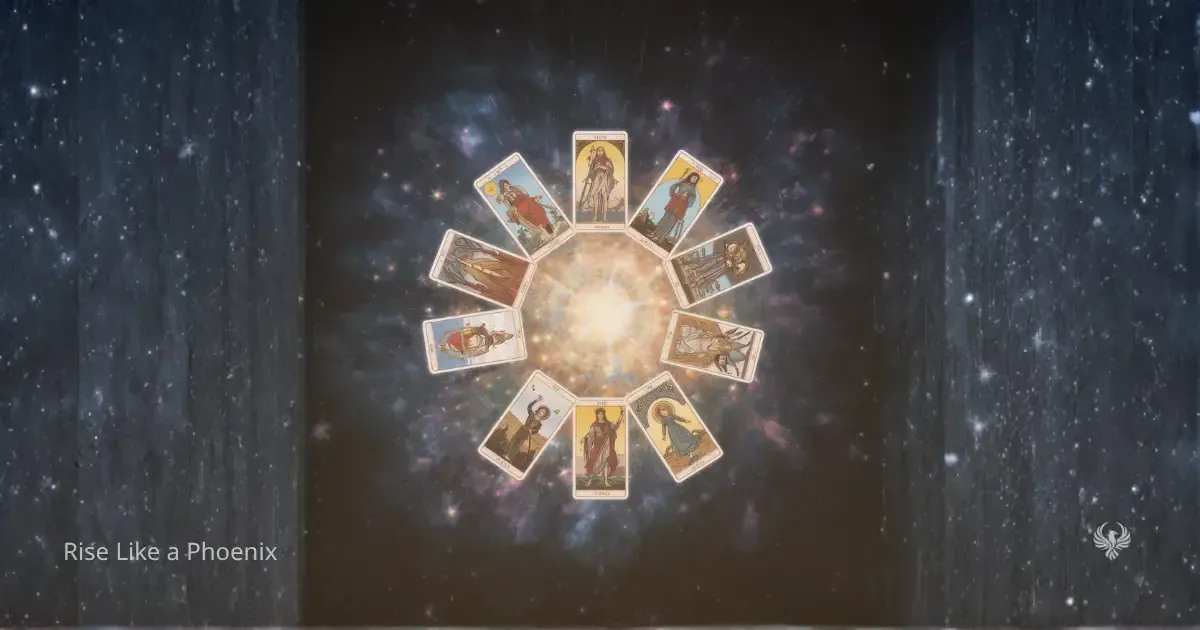
A Symbolic Guide to Inner Growth, Shadow, Surrender, and Wholeness
Some tarot cards seem to speak to ordinary life.
They describe a conversation, a choice, a delay, a conflict, a hope, a fear, or a practical situation that is already unfolding.
Other cards feel different.
When cards such as The Fool, The High Priestess, Death, The Devil, The Tower, Judgement, or The World appear, the reading may seem to widen.
The question may still be practical, but the card points to something deeper beneath the situation.
It may not ask: "What is happening?"
It may ask: "What is being awakened here?"
The Major Arcana carries this deeper quality. These 22 cards are often approached as spiritual archetypes, stages of inner development, and thresholds in consciousness.
They can be read as a symbolic map of the soul's movement through innocence, choice, desire, crisis, surrender, shadow, truth, and integration.
But this map must be understood carefully.
The Major Arcana is not a fixed script. It does not tell you exactly what will happen, who you are forever, or what stage of spiritual development you have permanently reached.
It is not a ladder of superiority.
It is not a prediction system.
It is a way of seeing.
The Major Arcana helps us recognize the deeper movements that often take place beneath visible events. It gives us symbolic language to the passages we go through when life asks us to become more conscious.
Some tarot cards speak to the day.
The Major Arcana often speaks to the threshold.
What Is the Major Arcana?
A traditional tarot deck contains 78 cards.
These cards are commonly divided into the Major Arcana and the Minor Arcana.
The Minor Arcana is made up of four suits and often speaks to the movements of daily life:
emotions
thoughts
choices
work
relationships
conflict
effort
uncertainty
change.
The Major Arcana contains 22 cards, beginning with The Fool and ending with The World.
These cards are often associated with:
larger archetypal patterns
spiritual lessons
initiations
turning points
inner transformations.
This does not mean the Major Arcana is "better" than the Minor Arcana.
Daily life is not spiritually inferior. Ordinary choices, conversations, habits, responsibilities, and relationships are often the places where deeper growth becomes real.
But the Major Arcana tends to point to the larger pattern beneath the immediate situation.
For example,
Two of Swords (Minor Arcana card) may show indecision, avoidance, or the need to make a choice.
The Lovers (Major Arcana card) may also involve choice, but it often points to something deeper: alignment, values, divided desire, inner union, or the responsibility of choosing from a more conscious place.
A Five of Pentacles (Minor Arcana card) may show hardship, exclusion, scarcity, or feeling unsupported.
The Tower (Major Arcana card) may also involve disruption, but it often points to the collapse of a structure that could no longer hold truth.
A Minor Arcana card may describe what is happening.
A Major Arcana card often asks what the experience is teaching, revealing, dismantling, or awakening.
For a broader foundation, see "Ultimate Guide to Tarot for Spiritual Growth: A Grounded Introduction to Tarot as a Reflective Practice for Awareness, Symbolic Insight, and Inner Authority".
A Map, not a Prediction
The Major Arcana is often described as a map of spiritual growth. That language can be helpful, but only if we understand what a map is.
A map does not walk the path for you.
A map does not remove choice.
A map does not guarantee that every person will experience the journey in the same order, with the same timing, or through the same outer events.
A map helps you orient.
When the Major Arcana appears in a reading, it does not necessarily mean that fate has taken over. It may mean that the situation is touching something larger within you.
The card may be showing:
a pattern becoming conscious
a threshold being crossed
a lesson being repeated
an old identity being challenged
a shadow being revealed
a form being released
a deeper truth asking for response
an aspect of the self, seeking integration.
This is why the Major Arcana can feel intense. These cards do not usually stay on the surface.
But intensity is not the same as doom.
For example,
Death does not automatically mean physical death or disaster.
The Devil does not mean you are evil or that someone else has total power over you.
The Tower does not mean punishment.
Judgement does not mean condemnation.
The World does not mean life is finished and nothing more needs to unfold.
Each card is a symbolic doorway. It invites reflection, not panic.
The cards do not remove choice. They reveal where choice has become more conscious.
A tarot map is not a command. It is a way of seeing.
This is one reason it helps to clear away common tarot misconceptions before working with the cards as spiritual symbols. Explore more in "Top Misconceptions About Tarot: And the Truths that Bring Clarity, Responsibility, and Freedom".
The Major Arcana as the Soul's Journey
To read the Major Arcana spiritually, it helps to understand the word "soul" in a grounded way.
The soul journey is not a fantasy of escaping human life. It is not about becoming untouchable, perfect, superior, or detached from ordinary responsibility.
The soul journey is the movement toward deeper awareness, truth, responsibility, compassion, and wholeness.
It is the slow process of becoming more honest about:
who we are
what we fear
what we desire
what we avoid
what we repeat
what we are being asked to embody.
The Major Arcana gives symbolic language to this movement.
The Fool begins before certainty.
The Magician discovers attention, will, and the power to choose.
The High Priestess listens beneath the surface.
The Empress opens the field of embodiment, nourishment, and creative life.
The Emperor introduces structure, boundary, order, and responsibility.
The Hierophant brings the encounter with teaching, tradition, spiritual structure, and the wisdom or limitation of inherited belief.
The Lovers brings the question of choice, values, union, and division.
The Chariot tests direction and disciplined will.
Strength teaches relationship with instinct, courage, and gentleness.
The Hermit turns inward to seek wisdom beyond noise.
The Wheel of Fortune reveals cycles, changes, and the limits of control.
Justice asks for truth, consequence, and alignment.
The Hanged Man teaches pause, surrender, and reversal of perspective.
Death releases what can no longer carry life.
Temperance begins the work of integration and inner alchemy.
The Devil reveals bondage to fear, shame, desire, attachment, or unconscious patterns.
The Tower breaks false structures.
The Star restores hope after rupture.
The Moon leads through uncertainty and the hidden realm of the unconscious.
The Sun brings clarity, vitality, and renewed innocence.
Judgement calls the deeper self into response.
The World reflects integration, completion, and wholeness embodied in life.
This is not a rigid sequence.
We do not pass through The Fool once and then leave it behind forever.
We do not encounter Death only once.
We do not reach The World and become permanently complete.
The journey is cyclical.
We return to the beginning many times.
We revisit lessons at deeper levels.
We meet the same card differently as we mature.
This is similar to reading tarot through karma: not as fixed fate, but as a way of recognizing patterns, responsibility, and conscious choice. Learn more: "Reading Tarot Through Karma Instead of Fate: A Reflective Approach to Patterns, Responsibility, and Conscious Choice".
The Fool at one stage of life may be innocence.
At another stage, The Fool may be the courage to begin again after loss.
Death at one stage may mean letting go of an expectation.
At another, it may mean surrendering an identity that once defined the self.
The Devil at one stage may reveal obvious attachment.
At another, it may expose subtle dependence on approval, control, suffering, or spiritual certainty.
The Major Arcana is not a straight line out of ordinary life.
It is a mirror of how consciousness moves through life.
The Fool's Journey: A Symbolic Path of Becoming
One common way to understand the Major Arcana is through the Fool's journey.
The Fool represents the soul at the beginning of the path: open, unformed, trusting, uncertain, and stepping into experience.
A deeper reflection on The Fool explores why spiritual beginnings often require stepping forward before certainty appears. Explore "The Fool in Tarot: Beginning Before Certainty".
This journey is not meant to be taken literally. It is not a rulebook.
It is a symbolic way of understanding how human consciousness develops through experience.
The Fool meets the archetypes of life.
The Magician teaches the power of attention and action.
The High Priestess teaches the power of silence, mystery, and inner knowing.
The Empress and Emperor introduce the worlds of nurture and structure.
The Hierophant brings tradition, teaching, belief, and inherited wisdom.
The Lovers asks what must be chosen and what must be aligned.
The Chariot tests the ability to move with direction.
Strength teaches that power is not only force. Sometimes, power is the capacity to remain present with instinct without becoming ruled by it.
The Hermit turns away from noise to seek the inner lamp.
The Wheel of Fortune reminds the Fool that life moves in cycles and not everything can be controlled.
Justice brings consequence, truth, and accountability.
The Hanged Man interrupts the forward push and asks for surrender.
Death ends the old form.
Temperance begins to blend what has been separated.
The Devil reveals where freedom has been traded for attachment, fear, or compulsion.
The Tower breaks what was built on illusion.
The Star offers healing after collapse.
The Moon leads the seeker through uncertainty, dream, fear, and the unconscious.
The Sun restores clarity and life.
Judgement calls for the self to rise, respond, and become accountable to a deeper truth.
The World gathers the journey into integration.
The Fool's journey is not only a story of progress. It is also a story of disruption, forgetting, returning, surrendering, and beginning again.
This matters because spiritual awakening is often misunderstood.
Awakening is not always blissful.
It is not always calm, beautiful, or certain.
Sometimes awakening begins when an old explanation stops working.
Sometimes it begins when we can no longer pretend not to know what we know.
Awakening can feel like clarity.
It can also feel like grief, disorientation, humility, or the collapse of a false identity.
The Major Arcana makes room for all of this.
It does not reduce the spiritual path to light alone.
Major Arcana Cards as Stages, Not Personality Labels
One mistake in tarot reading is turning the cards into fixed labels.
The Magician becomes "a powerful person".
The High Priestess becomes "an intuitive woman".
The Devil becomes "a toxic person".
Death becomes "something bad".
The Tower becomes "disaster".
The World becomes "success".
These interpretations may contain fragments of meaning, but they are too small for the Major Arcana.
A Major Arcana card is better understood as a stage, threshold, lesson, pressure point, or inner movement.
The Magician does not simply say, "You are powerful".
It may ask whether you can remain with mystery without forcing an answer before it is ready.
Death does not simply say, "This will end".
It may ask what form, role, expectation, habit, or attachment has already begun to lose life.
The Devil does not simply say, "This is bad".
It may ask where fear, shame, desire, survival pressure, or unconscious dependence has reduced inner freedom.
The Tower does not simply say, "Something will collapse".
It may ask what structure has become too false, too rigid, or too disconnected from truth to remain stable.
Judgement does not simply say, "You are being judged".
It may ask where life is calling you into honest response.
The World does not simply say, "You have finished".
It may ask what has been integrated enough to be lived more fully.
A Major Arcana card is not a label placed on the self.
It is a doorway through which the self is being asked to see more clearly.
The Major Arcana and Spiritual Awakening
The phrase "spiritual awakening" can easily become inflated.
It is sometimes imagined as a sudden arrival into light, certainty, mystical knowledge, or permanent peace.
But in lived experience, awakening is often much more grounded and much less glamorous.
Awakening may begin when you see a pattern you can no longer excuse.
It may begin when you realize that a familiar identity was built around protection rather than truth.
It may begin when you notice how fear has shaped your choices.
It may begin when you stop confusing intensity with love, control with safety, or avoidance with peace.
It may begin when you recognize that a life structure, relationship pattern, belief system, or inner story no longer holds what is real.
The Major Arcana can help us name these passages.
The High Priestess may awaken the capacity to listen inwardly instead of chasing external certainty.
The Hermit may awaken the need for solitude and discernment.
Justice may awaken the recognition that choices have consequences.
Death may awaken the humility to release an old form.
The Devil may awaken awareness of bondage.
The Tower may awaken truth by dismantling illusion.
The Star may awaken trust after rupture.
Judgement may awaken responsibility.
The World may awaken the possibility of integration.
Awakening is not only the arrival of light.
It is also the loss of permission to remain unconscious.
That does not mean awakening should be forced, romanticized, or turned into spiritual pressure.
Growth has timing.
The nervous system has limits.
The body matters.
Ordinary life matters.
The Major Arcana should not be used to push someone beyond their capacity.
It should help a person recognize what is becoming conscious, and then meet that recognition with grounded care.
Shadow, Surrender, and Integration in the Major Arcana
The Major Arcana is powerful because it does not exclude the difficult parts of the path.
It includes innocence and wisdom, but also bondage, collapse, grief, uncertainty, and surrender.
A complete spiritual map must make room for shadow.
Shadow is not simply evil.
It is what has been hidden, denied, feared, projected, or acted out unconsciously.
The Devil often reveals bondage: the places where attachment, shame, craving, control, survival fear, or self-deception keep the soul contracted.
The Moon reveals uncertainty, illusion, instinct, dream, fear, and unconscious material. It reminds us that not all confusion is failure. Sometimes the path is still hidden because something deeper is being revealed slowly.
The Tower reveals the instability of what was built on denial. It may feel violent because false certainty often feels safe until it breaks.
These cards can be uncomfortable, but they are not outside the path.
Shadow is not the opposite of awakening.
It is often the material through which awakening becomes honest.
The Major Arcana also makes room for surrender.
The Hanged Man teaches pause, reversal, and the wisdom of not forcing movement.
Death teaches release. It asks us to stop preserving a form that has already completed its life.
Temperance teaches the slow work of recombining what has been separated. It is not dramatic transformation. It is integration through balance, patience, and inner alchemy.
And then there is integration.
The Star restores trust after rupture.
The Sun brings clarity, vitality, and a more innocent relationship with life.
Judgement calls the self into response. It asks not only, "What do you understand?" but "How will you live now that you understand?"
The World reflects completion, not because nothing more will happen, but because something has become whole enough to be embodied.
This is one of the great gifts of the Major Arcana.
It does not ask us to identify only with the cards we prefer.
The Fool is not less sacred than The World.
The Devil is not outside the journey.
The Tower is not proof of failure.
Death is not the enemy of life.
The Moon is not regression.
Each card reveals part of the path.
Wholeness does not mean living only in the cards we prefer.
It means learning how every card reveals part of the path.
How to Read a Major Arcana Card in a Spread
When a Major Arcana card appears in a reading, it can be helpful to pause.
Rather than rushing to predict an event, ask what deeper movement the card may be naming.
You might ask:
- What stage of growth does this card reflect?
- What threshold is being crossed?
- What pattern is becoming visible?
- What part of me is being initiated, tested, released, or integrated?
- Where am I asking for certainty when the card is asking for consciousness?
- What responsibility does this card return to me?
- What would it mean to live this card, not only interpret it?
This approach changes the reading.
For example,
If Death appears in a relationship reading, the immediate fear may be, "This relationship will end."
That may or may not be true. But as a reflective card, Death asks a deeper question.
- What form of attachment is ending?
- What expectation has lost life?
- What version of the relationship are you trying to preserve?
- What identity have you built around this connection?
- What needs to be released so that truth can breathe?
In a career reading, The Devil may initially look like a warning about a toxic workplace or controlling person. Sometimes outer dynamics do need to be seen clearly.
But the card may also ask:
- Where do you feel bound?
- Where has survival fear taken authority?
- Where has ambition become compulsion?
- Where are shame, dependency, or approval shaping your choices?
- Where have you confused security with freedom?
If The World appears in a self-reflection reading, it does not mean everything is finished forever. It may show that a lesson has matured enough to be integrated.
A cycle may be complete not because life has stopped moving, but because you can now carry the lesson differently.
This is the difference between using the Major Arcana as prediction and using it as a map.
Prediction asks, "What will happen?"
The map asks, "What is this experience revealing, and how am I being asked to meet it?"
A Simple Major Arcana Reflection Practice
You can work with Major Arcana as a reflective practice even without doing a full reading.
One simple method is to separate the 22 Major Arcana cards from the rest of the deck and use them for a soul lesson spread.
Before drawing cards, take a moment to ground yourself.
Notice your body. Let the question become simple.
Then ask:
- Where am I in the journey right now?
This card reflects the stage, threshold, or archetypal pattern currently active.
- What lesson is this card asking me to see?
This card points toward the deeper teaching, challenge, or awareness emerging through the situation.
- What helps me integrate this lesson in daily life?
This card brings the reading back into action, embodiment, pacing, or grounded response.
After drawing the cards, do not rush to pull clarifiers.
Write down what you notice first.
- What image draws your attention?
- What feeling arises?
- What word or phrase comes forward?
- What part of the card comforts you?
- What part unsettles you?
- What does the card ask you to see without exaggerating or avoiding?
The first interpretation is not always the final one. Some cards need to be lived with before they are understood.
This is especially true with the Major Arcana. These cards often unfold over time.
A reading may not make complete sense in the moment. It may become clearer as the situation reveals what was already moving beneath the surface.
When the Major Arcana Feels Intense
Because the Major Arcana often touches deeper inner material, some cards can trigger fear or emotional intensity.
Death, The Devil, The Tower, The Moon, and Judgement are especially likely to provoke strong reactions.
That does not mean something terrible is about to happen.
A strong reaction may mean the card has touched a fear, memory, attachment, pattern, or threshold that already carries emotional charge.
Before interpreting from panic, pause.
Return to the body.
Breathe.
Feel your feet.
Notice whether the reading is creating clarity or spiraling fear.
Then ask a grounded question.
If Death scares you, ask:
What am I afraid to release?
If the Devil unsettles you, ask:
Where do I feel bound, and what gives that bondage power?
If the Tower alarms you, ask:
What structure in my life feels unstable, false, or unable to hold truth?
If the Moon confuses you, ask:
What am I trying to force into certainty before it is ready to be seen?
If Judgement feels heavy, ask:
Where am I being called into honest response without turning that call into self-condemnation?
The card that frightens us is not always the card that harms us. Sometimes it is the card that names what fear has kept unnamed.
This does not mean you should keep reading if you feel overwhelmed. Sometimes the most responsible tarot practice is to close the deck, drink water, move your body, speak to a trusted person, or return to ordinary life.
Tarot should support awareness. It should not pull you away from stability.
The Major Arcana as a Mirror of Wholeness
The Major Arcana is often described as a journey from The Fool to The World.
But the point of the journey is not to reject The Fool and become The World.
The Fool remains sacred.
The beginning remains sacred.
Not knowing remains part of the path.
The World is not superiority over the other cards. It is the integration of the journey.
Wholeness means more than light. It includes innocence, will, intuition, embodiment, structure, teaching, choice, discipline, courage, solitude, cycles, justice, surrender, death, balance, bondage, collapse, hope, uncertainty, clarity, awakening, and completion.
Every card belongs.
This is why the Major Arcana can be such a powerful mirror.
It refuses to divide the spiritual path into only beautiful experiences.
It includes the moments when we begin without certainty.
It includes the moments when we misuse will.
It includes the moments when we cannot hear our intuition.
It includes the moments when desire binds us.
It includes the moments when structures fall apart.
It includes the moments when hope returns quietly.
It includes the moments when we finally understand something we were not ready to see before.
The Major Arcana does not tell us to escape life.
It teaches us to recognize the soul moving through life.
Final Reflection: The Cards Do Not Tell You Who to Become
The Major Arcana can help us see life as more than random events.
It gives symbolic language to the passages of inner growth: beginning, choosing, seeking, surrendering, confronting shadow, releasing old forms, integrating truth, and returning to life with more awareness.
But the cards should never become a rigid spiritual script.
They do not tell you who must become.
They do not decide your path for you.
They do not replace your responsibility, your body, your discernment, or your lived choices.
Instead, they help you recognize where consciousness is asking to grow.
A Major Arcana card may appear when a situation is not only about the surface question. It may be showing a deeper threshold, a pattern, a lesson, a shadow, or an invitation into wholeness.
The cards do not complete the journey for us.
They help us recognize the journey while we are still inside it.