
The Devil in Tarot: The Patterns That Bind Us
The Devil in tarot is not simply a card of evil or fear. It reveals the patterns, attachments, desires, shame, and unconscious bonds that limit inner freedom so they can finally be seen clearly.

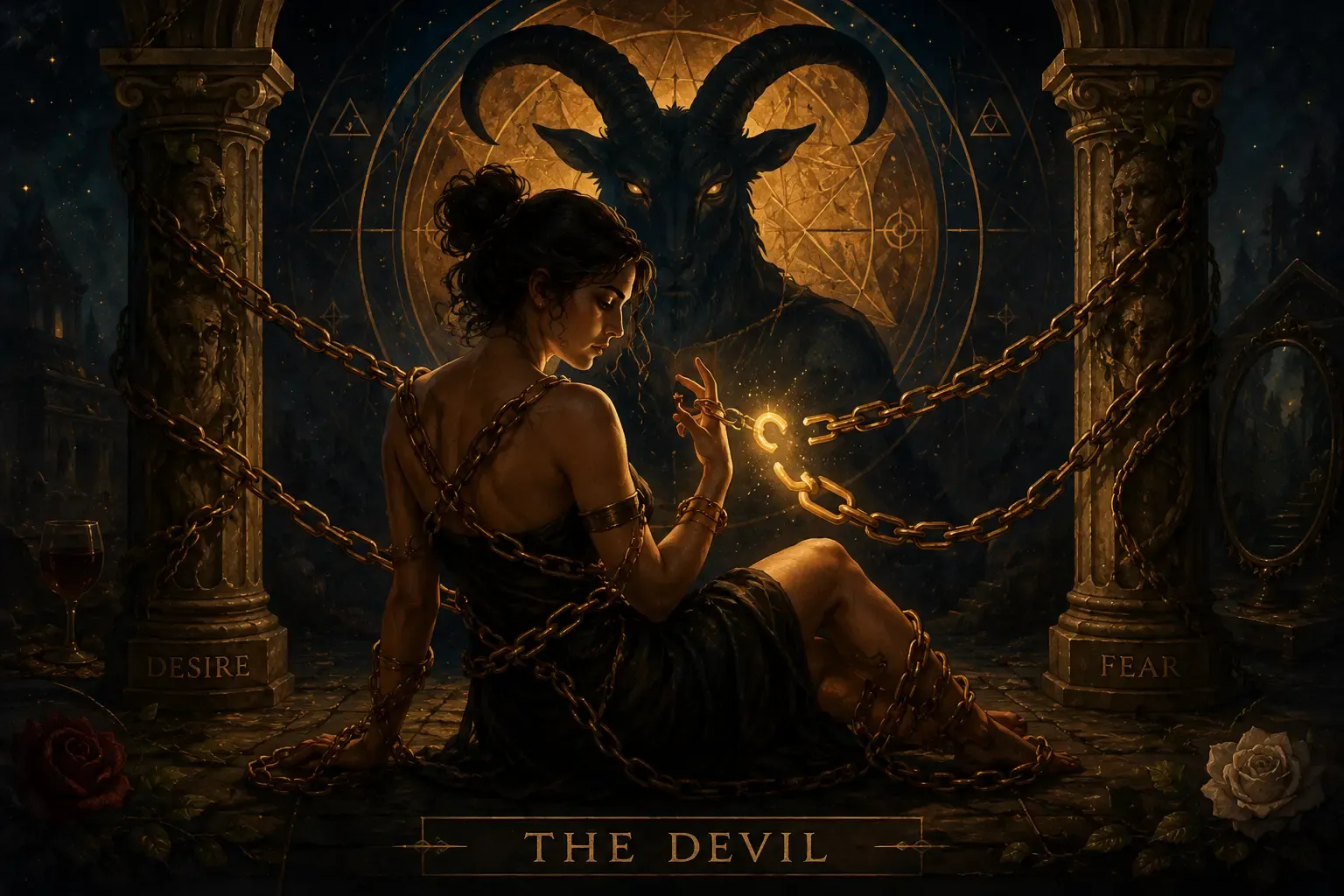
A Guide to Shadow, Attachment, and Inner Freedom
The Devil is one of the cards people often fear before they understand it.
The name itself can feel heavy. The image can bring up religious associations, shame, fear, temptation, or the idea that something dark has taken over.
But in tarot, The Devil is not usually about external evil.
It is about bondage.
It points to places where fear, shame, desire, attachment, compulsion, survival pressure, or unconscious patterns have taken too much authority over the self.
The Devil is uncomfortable because it does not only show what traps us. It asks where we have become entangled with the trap.
That does not mean blame.
It means recognition.
The Devil does not appear to condemn us. It appears to reveal what has power over us, so that freedom can become possible again.
The Devil in the Major Arcana Journey
In the wider journey of The Major Arcana as a Map of Spiritual Awakening, The Devil marks the stage where the seeker must face what has been given power through fear, desire, shame, or unconscious attachment.
Death asks what old form must be released.
The Devil asks what still has a hold on us.
That distinction matters.
Death is about ending, surrender, and transformation. It shows where a form has completed its life.
The Devil is about bondage. It shows where part of us may still be attached to a pattern, even when we know the pattern limits our freedom.
This card often appears when the lesson is no longer hidden.
Something has become visible.
The cost is known.
The pattern has repeated.
The body may already feel the contraction.
The mind may already understand the problem.
But something still pulls us back.
The Devil asks us to look directly at that pull.
Symbolism of The Devil
Different tarot decks portray The Devil in different ways, but the symbolism often points toward bondage, instinct, temptation, shadow, and unconscious attachment.
Many images of The Devil include chains. These chains may appear external, but symbolically they often point to internal bondage: fear, shame, craving, dependency, habit, belief, or emotional survival patterns.
The card may include darkness, fire, animal forms, distorted symbols, or figures who seem bound. These images can feel severe, but they are not only there to frighten the reader.
They are there to make the invisible visible.
In the Thoth deck, The Devil is not simply a moralized image of evil. The card has a strong earthy, generative, instinctual force. It can point to raw life-force, sexuality, appetite, materiality, and the power of the body when consciousness has not yet brought these forces into honest relationship.
This is important.
The Devil is not anti-body.
It is not anti-desire.
It is not anti-pleasure.
It asks whether our relationship with desire, pleasure, fear, control, or material life is conscious or compulsive.
The chain is not always the thing itself.
Sometimes the chain is our unconscious relationship to it.
The Devil Is Not Evil – It Is Bondage
The Devil does not usually say, "You are bad".
It asks:
What has taken your freedom?
Bondage can appear in many forms.
It can appear as addiction, compulsion, obsession, resentment, approval-seeking, control, secrecy, shame, overwork, dependency, avoidance, or the need for certainty.
It can appear in relationships.
It can appear in ambition.
It can appear in spiritual practice.
It can appear in the way we seek signs, readings, validation, or reassurance.
The Devil does not shame these patterns. Shame often keeps them hidden.
The card brings them into view.
That can feel uncomfortable because we may already know more than we want to admit.
We may know the relationship dynamic is not freeing.
We may know the habit has become a way to avoid feeling.
We may know the ambition is no longer rooted in purpose, but in fear.
We may know the repeated reading is not giving clarity anymore, but feeding the need for certainty.
We may know the pattern costs us peace, dignity, energy, or truth.
The Devil asks us to stop pretending that the chain is not there.
Attachment and the Loss of Inner Freedom
Attachment is not the same as love.
Desire is not the same as devotion.
Security is not the same as freedom.
The Devil often appears when something has become difficult to release because it is tied to fear, longing, shame, identity, or survival.
We may stay because being alone feels unbearable.
We may overwork because worth has become tied to achievement.
We may keep checking someone's behavior because uncertainty feels intolerable.
We may return to a pattern because it is familiar, even when it harms us.
We may confuse intensity with truth because calm feels unfamiliar.
We may seek one more sign, one more reading, one more confirmation, because direct choice feels too vulnerable.
This is where The Devil connects closely with inner authority in tarot. The card often reveals where inner authority has been handed over to fear, craving, approval, control, or the need for certainty as explained in Tarot and Inner Authority: Reclaiming Guidance Without Surrendering Responsibility.
The Devil does not ask us to become cold or detached.
It asks us to become honest about where attachment has reduced freedom.
A bond becomes a chain when we can no longer choose clearly.
The Devil and Desire
Desire is not the enemy.
This is one of the most important things to understand about The Devil.
Desire can be life-giving. It can show us what we value, what we long for, what we want to create, what we want to experience, and where life-force is moving.
The problem is not desire itself.
The problem is unconscious desire.
Desire becomes binding when it controls the self without being seen clearly.
Pleasure becomes binding when it becomes escape.
Ambition becomes binding when it consumes the body and soul.
Love becomes binding when it requires self-abandonment.
Spiritual seeking becomes binding when it becomes dependence on signs, teachers, cards, or certainty.
The Devil does not ask us to hate desire.
It asks us to see where desire has become a chain.
This is why the card can be deeply liberating. It does not demand rejection of the body, pleasure, power, money, sexuality, or material life. It asks for a more conscious relationship with them.
Can desire be named without shame?
Can appetite be felt without being obeyed automatically?
Can pleasure support life rather than numb it?
Can ambition serve truth rather than consume it?
Can longing be honored without handing over choice?
The Devil asks these questions honestly.
The Shadow of The Devil
Because The Devil already represents shadow, its shadow expression can be subtle.
The shadow is not only the bondage itself.
It is also the denial of bondage.
It is the projection of the pattern entirely onto someone else.
It is the shame that keeps the pattern hidden.
It is the belief that there is no choice.
It is the use of spiritual language to justify what is actually compulsion, avoidance, or control.
A person may say:
"This is just how I love."
"This is just how I survive."
"I cannot help it."
"They made me this way."
"I need this to feel safe."
"The cards keep telling me to wait."
"I am only seeking guidance/"
Sometimes those statements contain real pain. The Devil does not dismiss that pain.
But it asks whether pain has become the reason the chain remains unquestioned.
The deepest chain is often the belief that there is no way out.
Freedom may arrive all at once.
But it often begins when we stop calling bondage by another name.
When The Devil Appears in a Reading
When The Devil appears in a reading, pause before assuming something evil or doomed is present.
The card asks for honesty.
It may point to a pattern, attachment, desire, fear, dependency, or power dynamic that needs to be seen clearly.
In a relationship reading, The Devil may show attachment, obsession, control, dependency, shame, secrecy, intensity, or a repeated attraction to painful dynamics. This does not mean the other person is "the Devil". It means the reading is asking what pattern has power, and where freedom has been reduced.
In a career reading, The Devil may point to overwork, golden handcuffs, fear-based loyalty, identity tied to success, or staying in a role because leaving feels too threatening.
In a spiritual reading, The Devil may show dependence on signs, readings, teachers, systems, or certainty. It may appear when guidance has become reassurance-seeking, or when spiritual practice is being used to avoid direct action.
In self-reflection, The Devil often points to what we already know but feel unable to stop feeding.
This is not a reason for self-hatred.
It is a reason to become more honest.
The Devil does not show the chain so we can panic.
It shows the chain so we can begin to loosen it.
Questions to Ask When The Devil Appears
When The Devil appears, do not rush to project the card outward.
Let it ask what has power. You might ask:
- What has power over me right now?
- Where do I feel bound?
- What pattern do I keep finding even though I know its cost?
- What am I afraid would happen if I became free?
- What desire am I ashamed to name?
- Where am I confusing intensity with truth?
- Where have I handed over my choice?
- What chain is maintained by fear, shame, secrecy, or approval?
- What story makes this pattern feel impossible to leave?
- What small act would return one piece of freedom to me?
These questions keep The Devil grounded.
They allow the card to reveal shadow without turning the reading into blame, fear, or self-condemnation.
A Simple Practice with The Devil
To work with The Devil intentionally, place the card in front of you.
Take a few quiet breaths.
Notice your first reaction.
Do you feel fear?
Shame?
Resistance?
Recognition?
Defensiveness?
Relief?
Do not judge the response. The Devil often touches places where we are used to hiding from ourselves.
Then journal with three questions:
- What feels binding right now?
Name the situation, habit, attachment, desire, fear, or pattern as honestly as you can.
- What need, fear, or desire keeps this pattern alive?
This question matters because bondage often survives by meeting a real need in a distorted way.
The need may be safety, love, certainty, control, belonging, pleasure, rest, recognition, or relief.
- What is one small, honest action that returns choice to me?
Keep this action realistic.
Tell the truth in your journal.
Pause before repeating the old pattern.
Name the desire without acting on it immediately.
Ask for support.
Set one boundary.
Stop asking the same question for one day.
Take one practical step toward freedom.
This practice is not about shaming yourself.
Shame strengthens the chain.
Honesty begins to loosen it.
Freedom Begins with Seeing Clearly
The Devil is not an easy card, but it is not here to destroy us.
It is here to reveal bondage.
It shows where fear, desire, shame, control, or unconscious attachment has taken too much power.
It shows where we may have confused intensity with truth, dependence with love, survival with safety, or compulsion with choice.
The Devil does not ask us to reject the body.
It does not ask us to reject desire.
It does not ask us to become pure by denying the material world.
It asks us to become conscious in our relationship with these forces.
That is where freedom begins.
Not in denial.
Not in shame.
Not in pretending the chain is not there.
Freedom begins when the pattern can be seen clearly enough that another choice becomes possible.
The Devil does not show us the chain so we can hate ourselves.
It shows us the chain so freedom can become possible again.